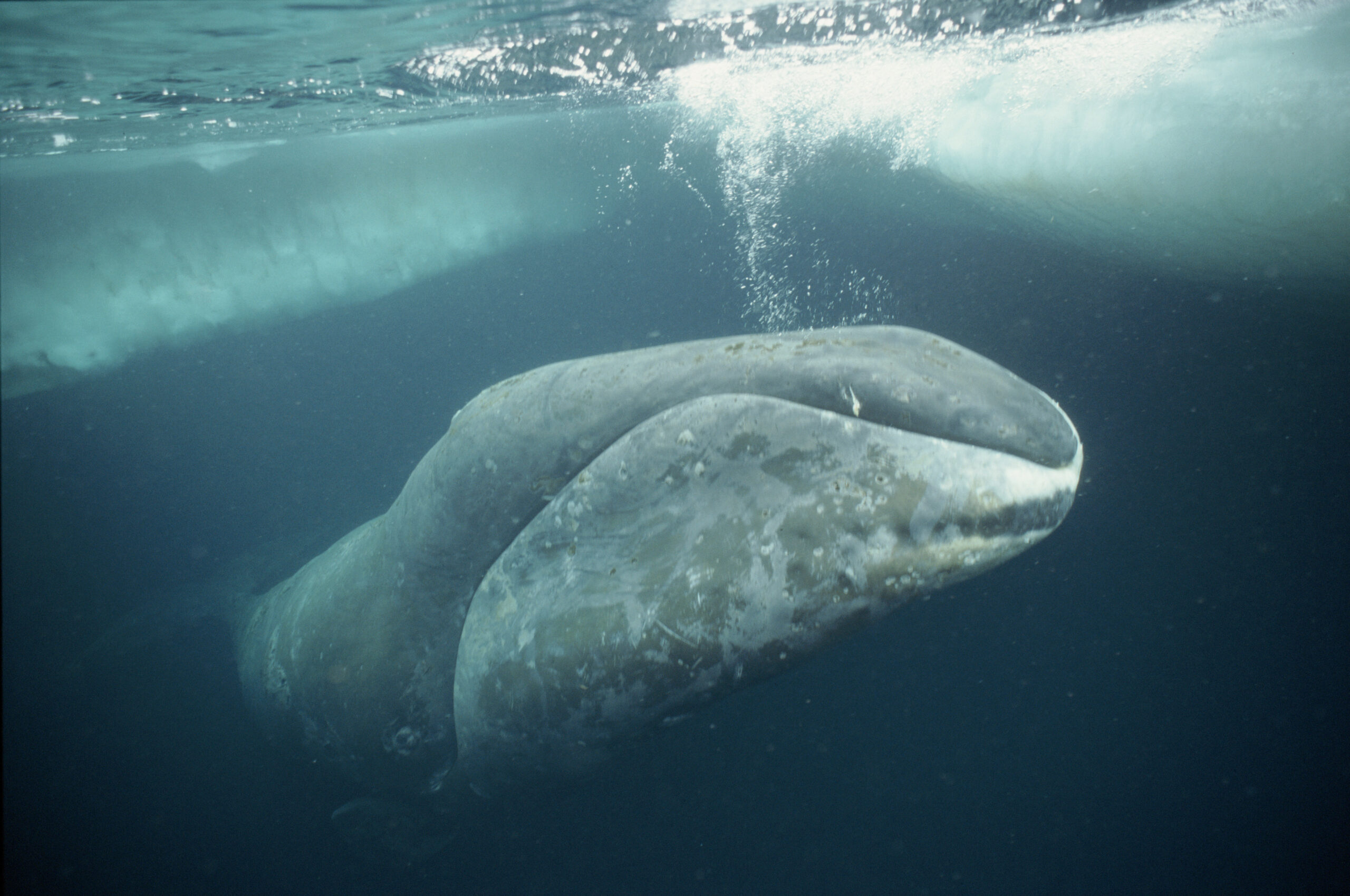
seaflog.com – The bowhead whale (Balaena mysticetus), a colossal and mysterious marine mammal, is one of the longest-living animals on Earth. Known for its remarkable longevity and thick skull, the bowhead thrives in the cold, icy waters of the Arctic. This unique species has captivated scientists and conservationists alike due to its extraordinary adaptations to extreme environments and its slow, majestic way of life.
Physical Characteristics
Bowhead whales are enormous creatures, reaching lengths of up to 60 feet and weighing between 75 and 100 tons. Their most distinctive feature is their massive, arched head, which makes up about one-third of their body length. This powerful head, along with a thick layer of blubber, allows bowheads to break through thick sea ice to breathe. They have the thickest blubber of any whale, which helps them survive the freezing Arctic temperatures.
Bowheads are baleen whales, meaning they filter feed by using baleen plates in their mouths to strain small organisms like plankton and krill from the water. Their baleen can reach up to 14 feet long, making it one of the longest in the animal kingdom.
Habitat and Range
Bowhead whales are uniquely adapted to the Arctic and sub-Arctic regions, where they are found year-round. Their range includes the Bering, Chukchi, Beaufort, and Greenland seas, as well as the waters around the Canadian Arctic Archipelago. Unlike many other whale species, bowheads do not migrate long distances but remain in their icy habitats, navigating through frozen waters and even breaking through ice as thick as 18 inches.
Diet and Feeding Behavior
Bowhead whales are filter feeders, primarily consuming zooplankton, including copepods, amphipods, and other tiny organisms. They are known to engage in a feeding technique called “skimming,” where they swim with their mouths open near the surface to capture large quantities of food. Bowheads feed primarily during the summer months when plankton blooms are abundant, storing energy to sustain them through the winter months when food is scarce.
Longevity and Reproduction
One of the most fascinating aspects of the bowhead whale is its extraordinary lifespan. Bowheads are known to live for more than 200 years, making them one of the longest-living mammals on the planet. Their slow aging process and delayed reproductive maturity—typically around 20 years of age—contribute to their longevity.
Female bowhead whales give birth to a single calf every three to four years after a gestation period of about 13 to 14 months. The calves are born in the spring, and the mothers nurse their young for several months, providing them with a thick layer of blubber to protect against the cold.
Conservation Status and Threats
Although bowhead whale populations are recovering, they are still listed as “Least Concern” by the International Union for Conservation of Nature (IUCN), with some subpopulations under threat. Historically, bowheads were heavily hunted for their blubber, baleen, and meat, especially during the 19th and early 20th centuries, when commercial whaling severely depleted their numbers. In some regions, populations were reduced by as much as 90%.
Today, bowheads face new challenges, including climate change, which is rapidly altering their Arctic habitat. Melting sea ice affects their feeding grounds, and the opening of the Arctic Ocean to shipping and oil exploration increases the risk of ship strikes, noise pollution, and oil spills. However, indigenous communities in Alaska and Canada continue to practice subsistence hunting of bowheads, a tradition that is carefully managed and regulated to ensure sustainability.
Cultural Significance
Bowhead whales hold great cultural importance for many indigenous Arctic peoples, particularly the Inupiat and Yupik communities in Alaska and the Inuit in Canada and Greenland. These communities have relied on bowhead whales for food, tools, and materials for centuries, and the whale remains central to their traditions, ceremonies, and ways of life. Indigenous hunting practices are deeply respectful of the animal, and hunts are conducted sustainably to ensure the species’ survival.
Conclusion
The bowhead whale is a symbol of resilience and adaptation in one of the harshest environments on Earth. With its incredible lifespan, unique adaptations to the icy Arctic, and vital role in the ecosystem, the bowhead continues to inspire awe and respect. While threats from climate change and human activity persist, ongoing conservation efforts, coupled with the sustainable practices of indigenous communities, offer hope for the future of this remarkable species.